TSMC's New Breakthrough in "Using Waste to Treat Waste" Yields More Than NT$10 Million in Green Benefits
Waste Etchant Transformed into Wastewater Treatment Chemical in Advanced Packaging, Driving Circular Economy


TSMC's Facility team independently developed a reuse technology for iron-containing waste etchant, converting waste liquid generated from advanced packaging and testing processes into a coagulation chemical for wastewater treatment. The reclaimed chemical partially replaces purchases of ferric chloride and realizes the green innovation goal of "using waste to treat waste." As of October 2026, the technology has been introduced to three advanced backend fabs, reducing outsourced waste liquid treatment by a total of 920 metric tons, as well as saving 280 metric tons of purchased chemicals, reducing carbon emissions by 140 metric tons, and generating NT$19 million in annual benefits. The technology has also been incorporated into the standard design of new fabs to further expand the benefits of resource circulation.
---------------------
TSMC is committed to becoming a global benchmark enterprise for environmental protection. Through the "High-Value Resource Action Plan," the Company converts waste resources into products that meet the high quality standards for reuse within its fabs. In order to utilize iron-containing waste etchant generated from advanced packaging and testing processes, the Facility department independently developed reclamation technology. Leveraging the coagulation and precipitation characteristics of iron ions, the team successfully converted the waste liquid into a ferric chloride substitute chemical that can be reused in wastewater treatment for fabs, realizing the green innovation goal of "using waste to treat waste." As of October 2026, this technology has been introduced to Advanced Backend Fab 3, Advanced Backend Fab 5, and Advanced Backend Fab 6. The Company has reduced outsourced waste liquid treatment by a total of 920 metric tons, saved 280 metric tons of purchased chemicals, and reduced carbon emissions by 140 metric tons, creating a comprehensive economic benefit of NT$19 million per year and demonstrating the broad value of resource circulation.
The solder bumping etching and cleaning processes in advanced packaging and testing generates waste etchant with high concentrations of iron ions, which was previously outsourced for treatment. To broaden resource circulation, TSMC's Facility department conducted a detailed analysis of the waste liquid components and discovered that it was rich in ferric sulfate. The team then set a two-stage strategy: "From Verification of Principles to Site Deployment," actively developing this waste liquid into a reclaimed resource that can replace purchases of ferric chloride.
In the first stage of verification, the team utilized the positively charged iron ions in the waste liquid and the negatively charged impurities in the wastewater to perform charge neutralization. After the reaction, insoluble flocs resembling cotton-like clusters were formed, which acted like a net to capture and precipitate fine suspended solids. This proved that the waste etchant possessed excellent coagulation effects and could perform the same water purification function as ferric chloride. To establish a standardized reuse mechanism, Advanced Backend Fab 3 was selected as the R&D starting point. Utilizing grinding wastewater from the manufacturing process, the team conducted jar tests with multiple sets of parameters, repeatedly cross-referencing and confirming the optimal pH value and chemical dosage to find the best dosage ratio.
After fully preparing the theoretical and operational parameters, the team initiated the second stage of the strategy: site deployment. They officially introduced the waste etchant into the coagulation process of the wastewater treatment system at Advanced Backend Fab 3. After confirming that effluent water quality and system performance were fully compliant with regulations, they set up a model for extending the technology to other advanced backend fabs to implement the concept of maximizing on-site resource circulation.
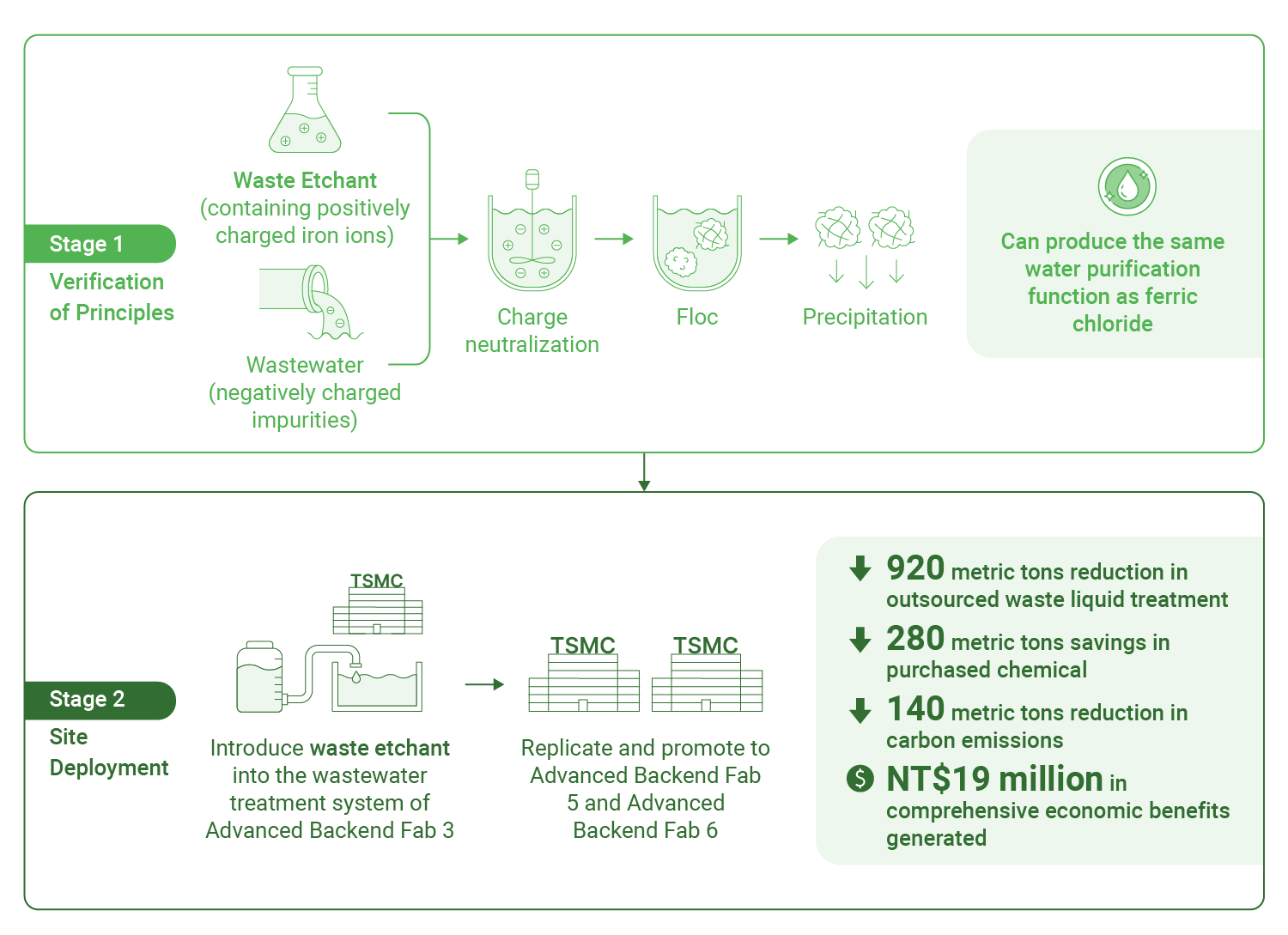
To broaden the value of resource reclamation, TSMC has incorporated this technology into the standard design of newly constructed advanced backend fabs. With the successive introduction of this technology to new fabs, it is estimated that by 2030, the cumulative reduction of outsourced waste liquid treatment will reach 6,300 metric tons, savings of purchased chemicals will reach 1,800 metric tons, and carbon reduction will reach 980 metric tons, creating an annual comprehensive benefit of NT$130 million. Furthermore, in the spirit of mutual prosperity, TSMC is also actively promoting this technology to packaging and testing peers with similar manufacturing processes, working together to expand the impact of resource circulation and make manufacturing greener.
- What is the "High-Value Resource Action Plan"?
The "High-Value Resource Action Plan" is one of TSMC's sustainable resource management plans. It aims to reduce off-site treatment and enable reuse in TSMC processes by expanding the types of waste liquid that can be converted into valuable recycled products.
- What is United Nations Sustainable Development Goals (SDGs) Goal 9?
The 17 goals set forth by the United Nations urge collaborative efforts from governments, industries, and academia worldwide to achieve sustainable development across social, economic, and environmental dimensions by the year 2030. SDG 9 focuses on "build resilient infrastructure, promote inclusive and sustainable industrialization and foster innovation."
- What is United Nations Sustainable Development Goals (SDGs) Goal 12?
The 17 goals set forth by the United Nations urge collaborative efforts from governments, industries, and academia worldwide to achieve sustainable development across social, economic, and environmental dimensions by the year 2030. SDG 12 focuses on "ensure sustainable consumption and production patterns."
Stay Connected
Subscribe to our newsletter for the latest updates and explore sustainability with us.
This site is protected by reCAPTCHA and the Google Privacy Policy and Terms of Service apply.