TSMC Adopts Nanobubble Cleaning to Create Environmental and Operational Synergies
Innovating Smart Monitoring Mechanisms to Save 760,000 m³ of Ultra-Pure Water Annually

.png)
To meet both the high standards of cleanliness of advanced processes as well as its ESG commitments, TSMC optimized equipment cleaning by deploying nanobubble technology and a self-developed, smart dual-closed-loop monitoring system. This integration reduces pipeline impurities and chemical consumption while accelerating new fab qualification by 35 days. Once fully rolled out across all 12-inch fabs in Taiwan, it will save 760,000 m³ of ultra-pure water annually, creating over NT$100 million in green value.
---------------------
TSMC actively practices sustainable water resource management. In response to its global manufacturing expansion and the stringent cleanliness standards of advanced processes, TSMC proactively enhanced its piping and equipment cleaning procedures. Starting in 2025, the Company introduced Nano-bubble Cleaning Technology. This method utilizes nano-bubbles to adsorb microscopic particles and leverages the micro-impact forces generated when bubbles burst. Coupled with TSMC's self-developed "Real-time Bubble Quality Monitoring and Auto-tuning Mechanism," this technology successfully reduced piping particles and impurities by 70% and halved chemical usage, shortening the tool qualification schedule for new fab construction by up to 35 days. As of September 2026, this technology has been deployed at Fab 12A and the Global R&D Center. Once the technology is fully implemented across all 12-inch wafer fabs in Taiwan, it is projected to save 760,000 cubic meters of ultra-pure water annually (equivalent to the volume of 304 Olympic-sized swimming pools) and generate approximately NT$100 million in green value, creating win-win for both environmental sustainability and company growth.
Smart Monitoring Ensures Both Quality and Efficiency
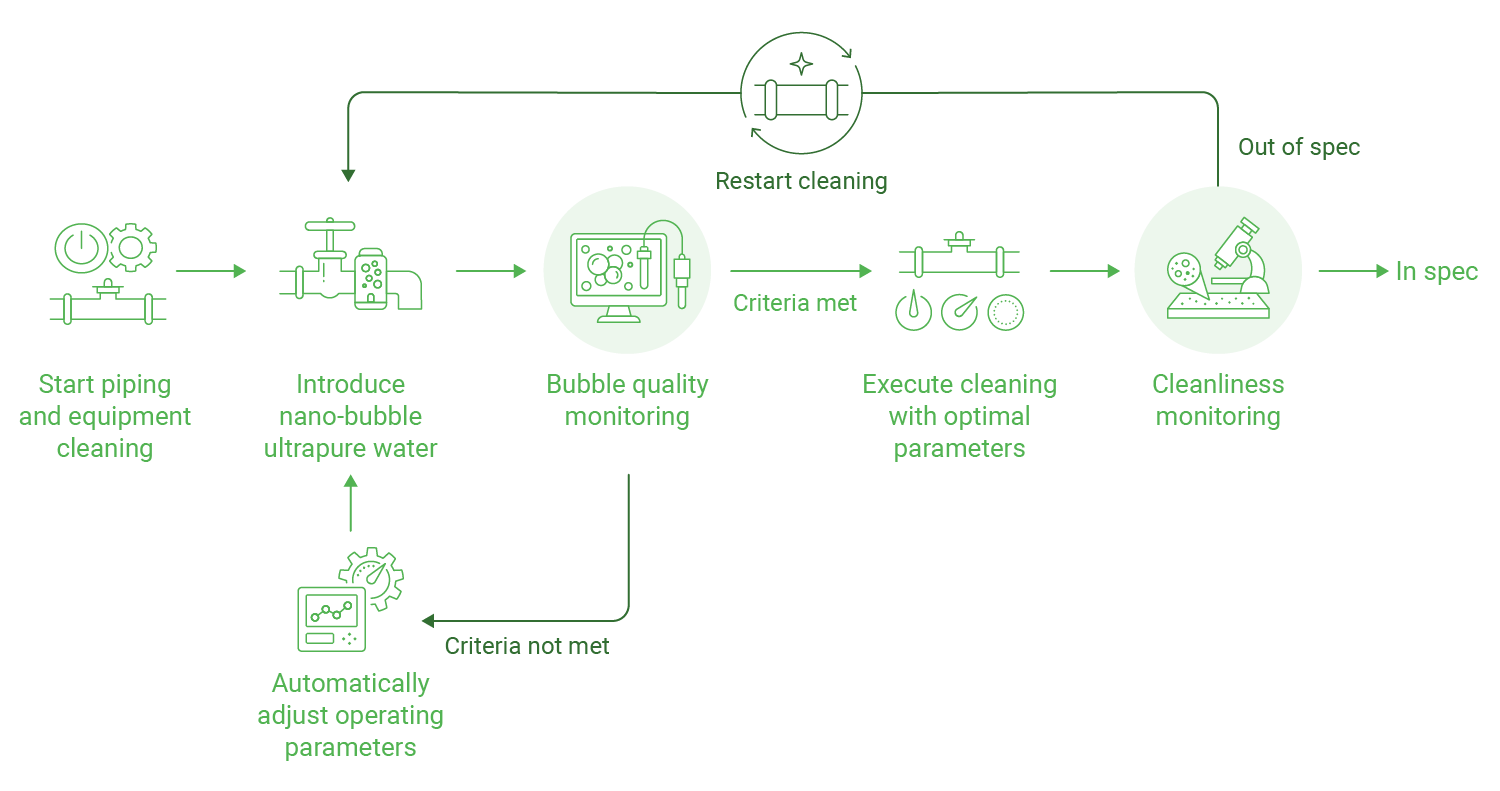
Chemical supply systems in wafer fabs require regular cleaning with ultra-pure water to maintain supply stability and process quality. To further optimize water efficiency as well as operational effectiveness, TSMC's facility team integrated nano-bubble cleaning technology with their operational experience in the factory, establishing a dual monitoring threshold for both "bubble quality" and "cleanliness." First, the system conducts real-time monitoring to verify the particle size, concentration, and surface charge of the nano-bubble. If they do not meet the criteria, parameters are automatically adjusted to their optimal state. Next, the level of cleanliness during the wash process is inspected, and the cleaning cycle is automatically restarted if process specifications are not met. This dual-closed-loop smart cleaning mechanism not only reduces chemical usage but also leverages automated controls to ensure every operation meets high quality standards.
To scale the benefits of this technology, TSMC adopted a two-stage rollout strategy. The first phase focuses on the chemical mechanical planarization (CMP) slurry supply systems in existing 12-inch wafer fabs, deploying nano-bubble ultra-pure water (UPW) to eliminate residual microparticles in the pipelines. This not only improved cleanliness but also drove a 62% improvement in wafer defect reduction performance. The second phase expands the technology to production equipment and pre-wash tanks in new fabs. By fully optimizing cleaning workflows, the system qualification timeline was accelerated by 35 days, synergizing green manufacturing with rapid capacity expansion.
In alignment with United Nations Sustainable Development Goal 6 (SDG 6) — Clean Water and Sanitation, TSMC not only optimizes its own water utilization mechanisms and cleaning quality, but also continues to expand the impact of its green innovations. This technology has been extended to supply chain partners, assisting chemical tank suppliers in improving cleanliness right from the source to collaboratively practice sustainable water resource management, helping to build a thriving semiconductor ecosystem.
- What is United Nations Sustainable Development Goal 6?
The United Nations has set 17 Sustainable Development Goals, calling on governments, businesses, academia, and society to work together to achieve sustainable development across social, economic, and environmental dimensions by 2030. SDG 6 focuses on "ensure availability and sustainable management of water and sanitation for all."
- Why is TSMC introducing nanobubble cleaning technology, and what are the benefits?
In response to the demands of global fab expansion and the stringent cleanliness standards of advanced processes, TSMC proactively enhances piping and equipment cleaning procedures. By using nanobubbles to adsorb microscopic particles and utilizing the micro-impact forces created by bursting bubbles, and coupled with TSMC's self-developed "Real-time Bubble Quality Monitoring and Auto-tuning Mechanism", this technology reduces pipeline impurities by 70% and halves chemical usage, shortening the tool qualification schedule for new fabs by up to 35 days.
Stay Connected
Subscribe to our newsletter for the latest updates and explore sustainability with us.
This site is protected by reCAPTCHA and the Google Privacy Policy and Terms of Service apply.