TSMC Enhances Supply Chain Water Governance, Boosting Improvement Rate by 85.7%
Empowering 15 Suppliers to Optimize Wastewater Management and Jointly Build a Green Ecosystem

.png)
To strengthen green supply chain management, TSMC launched the "Key Supplier Wastewater Discharge Supervision Enhancement Program," evaluating 425 suppliers based on three major indicators while conducting on-site visits to 15 high-risk partners and proposing 140 improvement recommendations. The audit results were continuously tracked and guided through the Supply Online 360 platform, with the improvement rate reaching 85.7%. In addition, in September 2026, TSMC will launch an interactive course on the "TSMC Supplier Sustainability Academy" platform to share systematic wastewater management practices and collaborate with the supply chain for mutual benefits.
-----------------
To keep pace with the rapid development of the semiconductor industry, TSMC continues to improve its supply chain sustainability risk management. The Company refines its environmental, safety, and health (ESH) management through a four-step framework: "Standard and System Establishment, Audit and Violation Tracking, Consultation and Training, and Supplier Follow-up Consultation." In 2025, TSMC launched the "Key Supplier Wastewater Discharge Supervision Enhancement Program." Under this initiative, the Company surveyed 425 critical raw material suppliers while selecting 15 high-risk suppliers for on-site audits. TSMC proposed a total of 140 improvement recommendations, and as of July 2026, the completion rate of these improvements reached 85.7%. Furthermore, TSMC has transformed its mentoring experience into a public good, sharing common wastewater management deficiencies and corrective actions at ESH-related forums to lead the supply chain toward a mutually beneficial green transition.
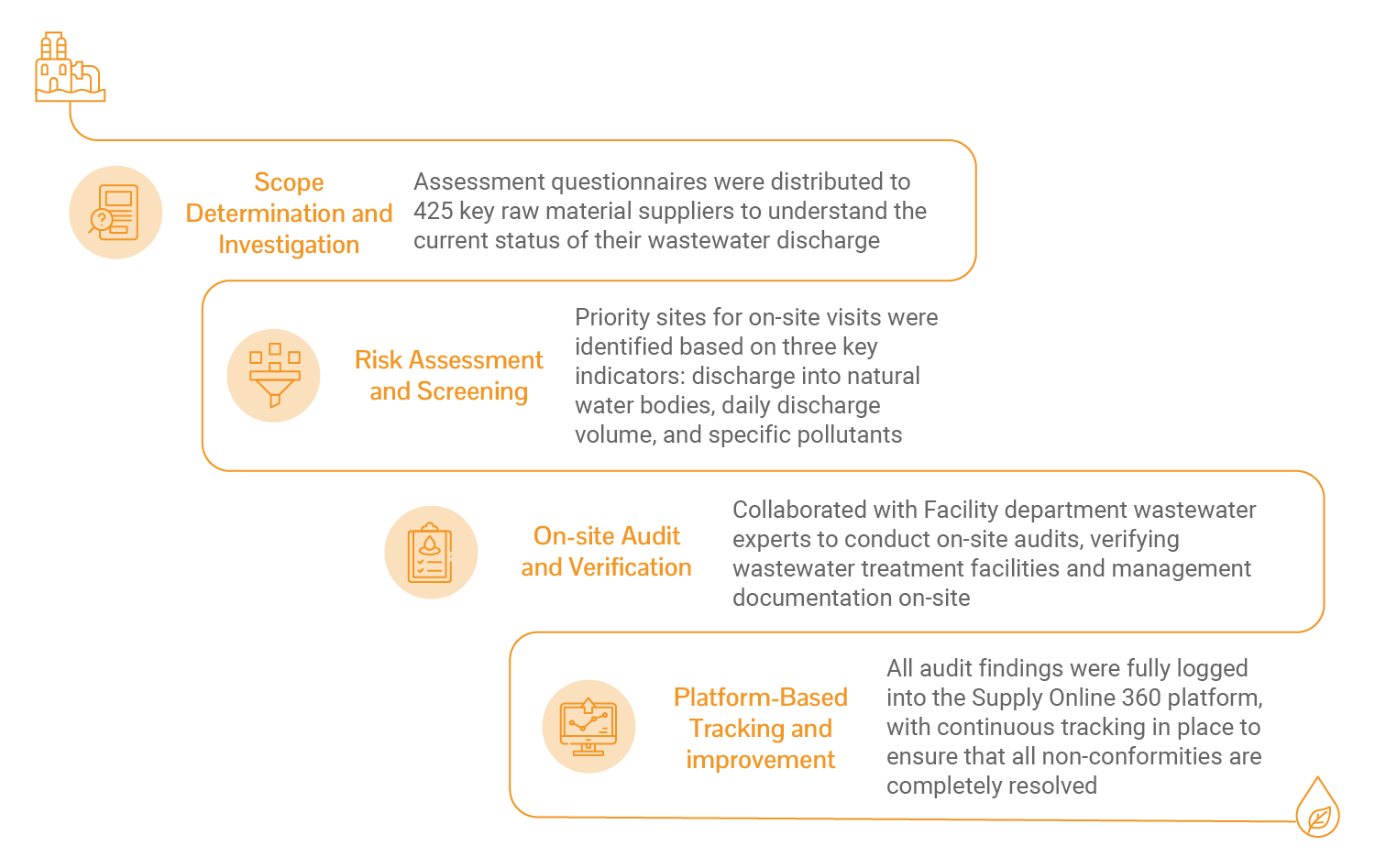
To enhance supplier sustainability performance, TSMC first evaluated the risk levels of 425 suppliers using an assessment questionnaire based on three major indicators: "whether wastewater is discharged into natural water bodies, daily wastewater discharge volume, and whether process wastewater contains specific pollutants." Using these indicators, 15 high-priority suppliers were screened for on-site visits. Wastewater experts from TSMC’s Facility department were deployed to these sites to review treatment equipment and management documents one by one using the seven major themes and key indicators of the "Wastewater Management Audit Checklist." At the same time, interviews were conducted with suppliers' senior executives to drive top-down resource commitment. All audit results were logged into the global responsible supply chain management platform, Supply Online 360, while suppliers were mentored and tracked until all improvements were completed, further strengthening the environmental resilience of the supply chain.
| Item | Key indicators |
|---|---|
| Compliance with Water Pollution Control Measures Plan and Permits |
|
| Competence and Execution of Designated Staff |
|
Reporting and Water Balance Diagrams |
|
| On-Site Facilities and Treatment Process Units |
|
| Wastewater Quality Monitoring and Measurement |
|
| Emergency Preparedness and Response Drills |
|
| Others |
|
We sincerely appreciate TSMC's audit and guidance, which helped our plant optimize operating parameters to refine our wastewater treatment system, laying a solid foundation for our continued commitment to high standards of environmental management.
We are deeply grateful for this opportunity for in-person exchange, which has inspired our company to review our existing wastewater treatment models with a fresh perspective and further improve our wastewater management through continuous improvements.
A resilient supply chain is the cornerstone of TSMC's robust operations. Through the "Key Supplier Wastewater Discharge Supervision Enhancement Program," TSMC executes source management while empowering suppliers to upgrade their technologies. To expand the win-win outcome of growing together, an interactive course titled "Common Deficiencies and Corrective/Preventive Measures in Supplier Wastewater System Management" is scheduled to launch in September 2026 on the open education platform "TSMC Supplier Sustainability Academy." By sharing systematic management strategies and practical insights, TSMC continues to exert its industry influence, internalizing high-quality standards into the green DNA of the semiconductor ecosystem.
- How does TSMC enhance supply chain sustainability risk management?
Enhancing sustainability risk management is one of TSMC's strategies for sustainable supply chain management. The Company requires suppliers to use the TSMC "Supplier Code of Conduct" as their basis for action, improving human rights performance in labor, safety and health, environmental protection, business ethics, and management systems. At the same time, TSMC actively guides suppliers to improve their core capabilities, mitigating the risk of operational disruption.
- How does TSMC assess suppliers' wastewater discharge risks, and what are the current achievements?
Through assessment questionnaires, TSMC evaluated the risk levels of 425 critical raw material suppliers based on three major indicators: "whether wastewater is discharged into natural water bodies, daily wastewater discharge volume, and whether process wastewater contains specific pollutants." This process identified 15 high-risk suppliers for prioritized on-site audits, proposing a total of 140 improvement recommendations. As of July 2026, the improvement completion rate reached 85.7%.
Stay Connected
Subscribe to our newsletter for the latest updates and explore sustainability with us.
This site is protected by reCAPTCHA and the Google Privacy Policy and Terms of Service apply.