TSMC's Parts Localization Program Drives Over NT$2 Billion in Annual Output Value
Empowering the Technical Capability of 12 Suppliers, Fostering Shared Prosperity

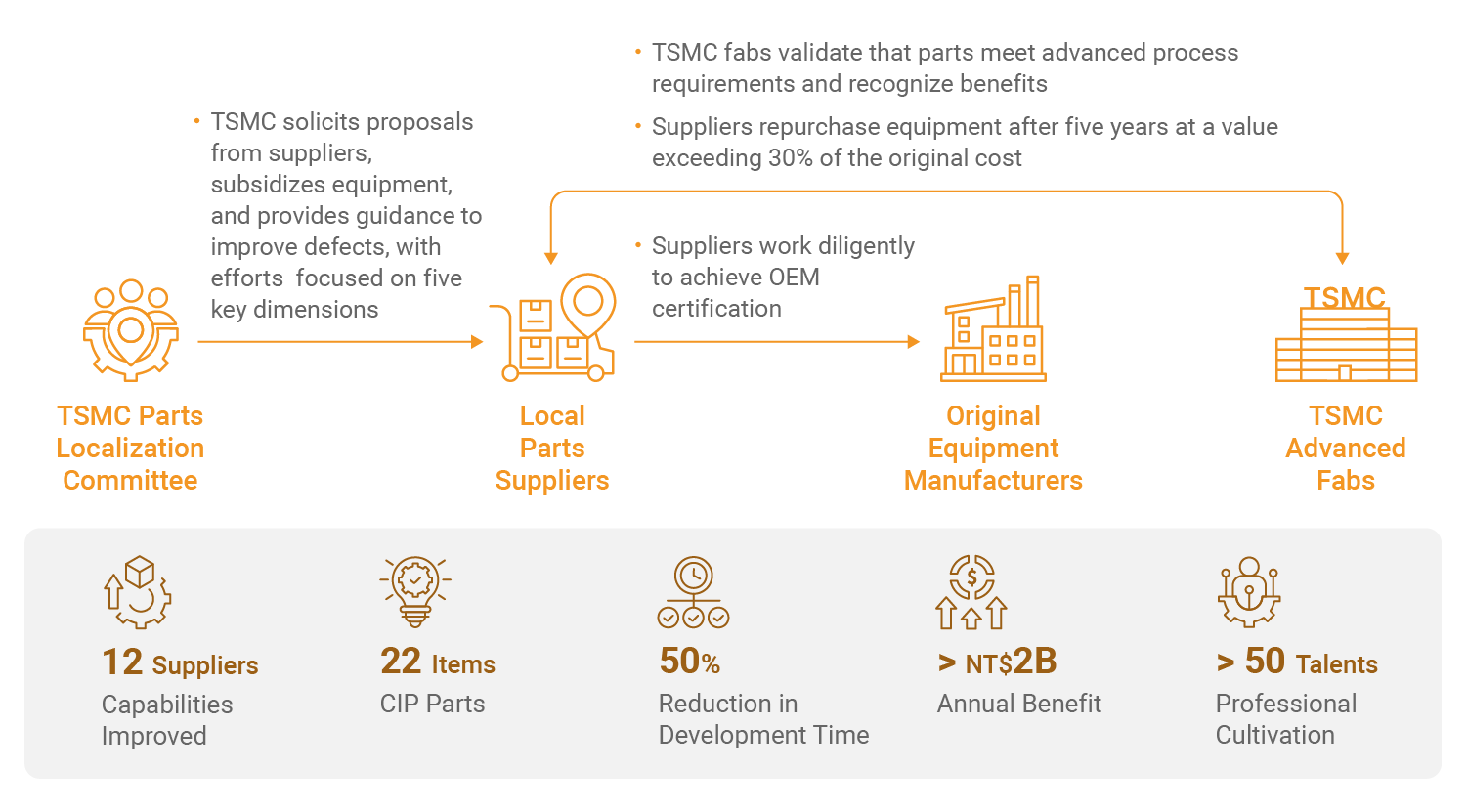
TSMC firmly believes that a responsible supply chain is the cornerstone of sustainable corporate operations. To this end, the Company actively drives supplier transformation and upgrading, designating "increasing the proportion of locally sourced parts in Taiwan" as a long-term strategic objective, with execution progress disclosed in its sustainability report. To meet the stringent demands of advanced process technologies and enhance the research, development, and manufacturing capabilities of local suppliers, TSMC launched the "Parts Localization and Innovation Program" in 2024. This initiative follows a dual approach of financial support and technical guidance. In addition to subsidizing suppliers for acquiring precision equipment and optimizing their development capabilities, the program introduces a unique benefit recognition and rebate mechanism. This mechanism acknowledges the commercial value generated based on the actual quantity of parts procured and utilized by TSMC, which is then offset against the suppliers' equipment buy-back costs after five years, fostering a mutually beneficial, win-win collaboration model. As of February 2026, TSMC has collaborated with 12 suppliers to successfully develop 22 Continuous Improvement Process (CIP) solutions, which have reduced parts validation and development lead times by 50%. This initiative has driven an annual output benefit exceeding NT$2 billion, demonstrating the tangible impact of supply chain localization.
TSMC adheres to its core philosophy of “building a responsible supply chain,” dedicating resources to support local suppliers in advancing their parts manufacturing technologies, thereby achieving sustainable operations and mutual prosperity.
Equipment Support and Buy-Back Mechanism: Realizing a Win-Win Cooperation Model
To ensure supplier technological development meets the stringent demands of advanced process technologies, TSMC established the "Parts Localization Committee." This committee focuses on five critical technology domains, including metal machining, brittle materials, ceramic sintering, surface coatings, and rubber O-rings. It publicly invites supplier proposals and subsidizes equipment purchase costs for qualified participants. Also, TSMC offers professional guidance and defect improvement support across five key dimensions: material physical and chemical property analysis, optimal geometric design simulation, critical parameter specification definition, machining process flow optimization, and advanced process validation. This comprehensive support accelerates suppliers' capabilities to produce parts that meet TSMC's rigorous standards.
.png)
Through in-depth analysis of key indicators such as material elemental composition, mechanical, thermal, electrical, and optical properties, TSMC assists suppliers in precise material selection, reducing process risks and enhancing stability
.png)
TSMC's simulation team (tSIM) conducts design verification for parts, focusing on geometry, structure, and dimensions. Using simulation software, the team predicts performance in actual manufacturing processes, optimizing efficiency and reducing manufacturing costs
.png)
Based on process requirements, TSMC defines critical technical parameters and specifications for parts, including dimensional tolerances, surface roughness, and material properties. This standardizes supplier development processes and ensures consistent quality
.png)
TSMC collaborates with suppliers to review processing paths, tool selection, cutting parameters, and jig and fixture designs. It provides technical guidance to enhance manufacturing precision, shorten processing cycles, and improve production efficiency
.png)
TSMC tests supplier-developed parts in production environments through simulated trials and actual machine validation. This evaluates their performance and durability comprehensively, ensuring compliance with process requirements and thereby enhancing production efficiency
Furthermore, to foster long-term collaboration and sustainable development, TSMC has launched a benefit recognition and rebate mechanism. This mechanism recognizes the commercial benefit generated from the procurement and utilization of supplier-produced parts, allowing the recognized benefit to offset suppliers' equipment repurchase costs after five years. To ensure fairness and protect the interests of both parties, a minimum repurchase price is set, stipulating that it cannot be lower than 30% of the original equipment cost. This initiative encourages suppliers to maintain their equipment effectively and maximize its utility. Also, by advancing their technological capabilities, suppliers can strive to become certified Original Equipment Manufacturer (OEM) suppliers, authorized to produce parts that meet industry standards. Through continuous value creation and asset accumulation, this mechanism enables both parties to achieve mutual growth and sustainable operations.
Promoting the continuous upgrade of local supply chains is not only a testament to TSMC's deep-rooted commitment to Taiwan but also a key strategic response to global market challenges. Through the successful implementation of the "Parts Localization and Innovation Program," TSMC has partnered with local suppliers to build a more resilient and competitive industrial ecosystem. The proposal solicitation for this year is scheduled to commence in March 2026, aiming to attract more parts suppliers to participate in technological innovation. Together with TSMC, these suppliers will contribute to co-creating a sustainable future for the semiconductor industry.
Stay Connected
Subscribe to our newsletter for the latest updates and explore sustainability with us.
This site is protected by reCAPTCHA and the Google Privacy Policy and Terms of Service apply.