TSMC Leads in Smart Logistics, Setting New Standards for Green Transformation
Driving Regulatory Change: TSMC Establishes the Nation's First Compliance Model for Paperless Customs

.png)
TSMC collaborated with government agencies to promote the "Paperless Customs Clearance" project, leading to the amendment of the "Regulations Governing the Bonding Operations in Science Parks" and becoming the first to adopt the new system. The Company also mobilized reclaimed wafer suppliers to join the initiative, eliminating 1.77 million sheets of paper annually, while extending the project's benefits to over 1,200 bonded operators nationwide. In addition, TSMC deployed smart logistics, adopting electronic logistics monitoring devices and a digital platform to achieve real-time cargo tracking while monitoring the status of critical cargo, strengthening transportation safety.
------------------------------
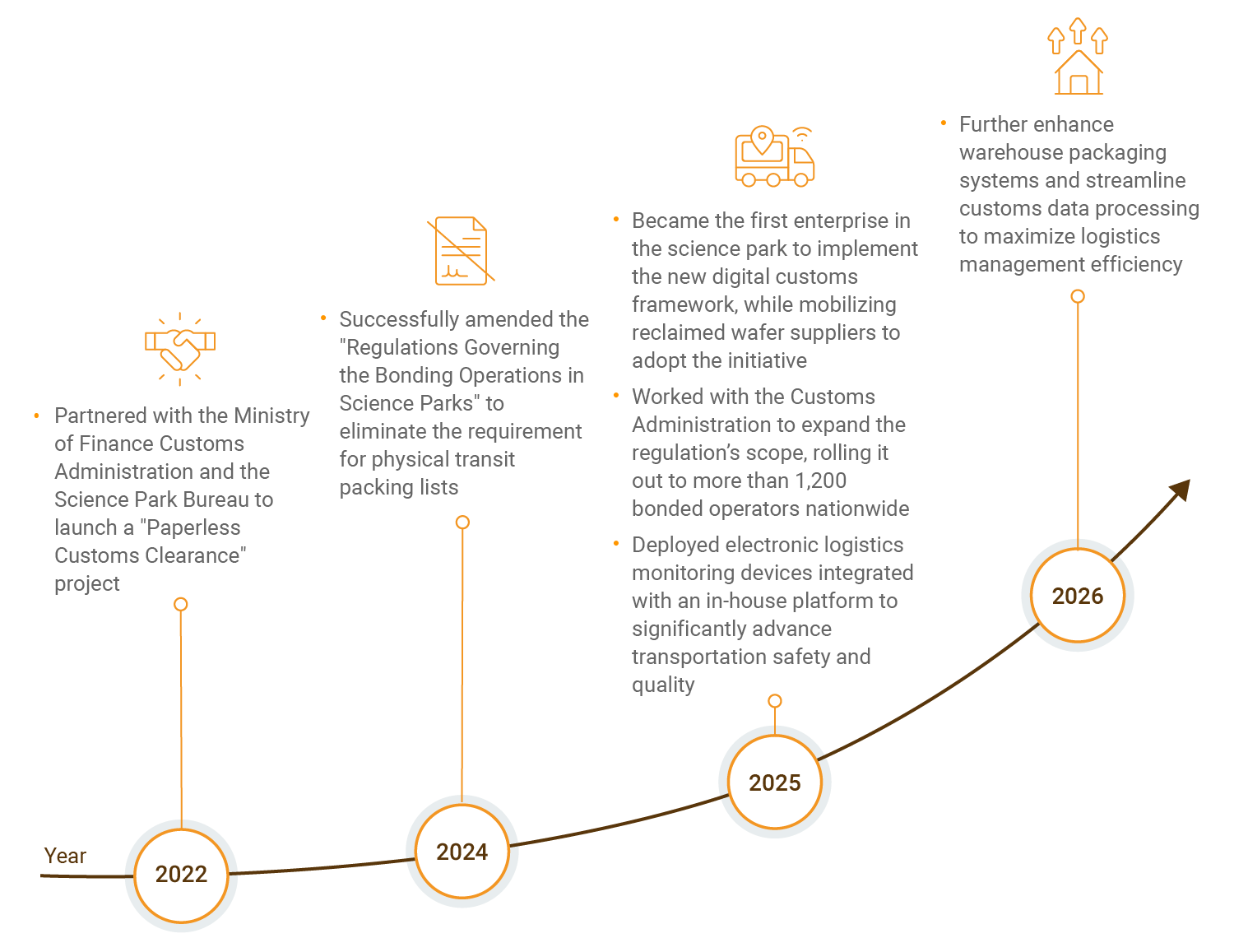
TSMC is committed to building a low-carbon semiconductor supply chain and actively driving digital transformation to optimize logistics efficiency. Partnering with the Customs Administration of the Ministry of Finance and the Science Park Bureau, TSMC launched a "Paperless Customs Clearance" project, amending regulations to streamline processes and rolling them out to over 1,200 bonded operators nationwide. In addition, TSMC adopted electronic logistics monitoring devices integrated with its internally developed platform, enabling real-time cargo tracking to significantly advance transportation safety and quality. TSMC has further enhanced warehouse packaging systems and simplified the data-entry process for customs declaration in June 2026, integrating sustainability to make logistics management more efficient.
Historically, cargo transportation within science parks relied on paper-based customs clearance that required physical packing lists to be attached to shipments. Custom brokers then had to manually submit these forms to Customs the month following delivery. To improve environmental sustainability and enhance logistical efficiency, TSMC launched the "Paperless Customs Clearance" project in 2022, proactively collaborating with the Customs Administration and the Science Park Bureau. After three years of dedicated efforts, this collaboration culminated in the 2024 amendment to the "Regulations Governing the Bonding Operations in Science Parks," officially abolishing the requirement for physical transit packing lists. As a result, TSMC became the first science park enterprise to adopt the new digital framework.
TSMC also rallied reclaimed wafer suppliers to join the initiative. This collective effort eliminates 1.77 million sheets of paper and saves 1,700 operational hours each year. It also significantly mitigates the risk of repetitive-strain musculoskeletal injuries among warehouse personnel, creating a win-win for both environmental protection and workplace health. Building on this success, in 2026 TSMC further optimized its warehouse packaging systems. Through process digitalization and standardization, the Company has effectively streamlined customs data processing, maximizing the efficiency of logistics management.
To improve logistics management, TSMC not only streamlines customs clearance processes but also leverages technology to improve the stability of cargo transportation. In 2025, the Company adopted electronic logistics monitoring devices integrated with an in-house platform. These devices enable real-time cargo tracking while transmitting critical environmental data, including temperature, humidity and vibration levels. This allows TSMC to instantly detect anomalies and eliminates the cumbersome process of determining liability when cargo is damaged, which is projected to save TSMC employees and logistics partners 1,800 man-hours annually.
By strengthening logistics and operational excellence through digital transformation, TSMC is actively leading the industry toward sustainable development. Looking ahead, TSMC will continue to expand these achievements across its supply chain partners. In addition, plans are underway to scale the application of electronic logistics monitoring devices to a wide range of cargo types, including equipment, finished goods, and raw materials, and a mobile application is under development to enable real-time visualization of cargo locations and seamless transit tracking. Through these initiatives, TSMC aims to forge a highly efficient, intelligent, and sustainable semiconductor supply chain ecosystem.
- What is the "Paperless Customs Clearance" project, and what are its tangible benefits for the environment and enterprises?
TSMC collaborated with the Customs Administration of the Ministry of Finance, and the Science Park Bureau to drive the "Paperless Customs Clearance" initiative. This initiative amended regulations to simplify cargo clearance processes, making TSMC the first enterprise to adopt the new system. At the same time, the Company partnered with reclaimed wafer suppliers to join the initiative, successfully eliminating 1.77 million sheets of paper while saving 1,700 operational hours annually. Subsequently, the Customs Administration expanded the scope of the project to over 1,200 bonded operators nationwide.
- How does TSMC leverage digital technology to ensure cargo transportation safety?
TSMC adopted electronic logistics monitoring devices to track cargo location, temperature, humidity, and vibration levels in real time. This ensures prompt detection of anomalies while eliminating the cumbersome follow-up process for cargo damage, which is projected to save 1,800 working hours annually.
- What are TSMC's plans for smart logistics?
TSMC plans to expand the application of electronic logistics monitoring devices to a wide range of cargo types, including equipment, finished goods, and raw materials. Looking ahead, TSMC plans to develop a mobile application to achieve real-time visualization of transit locations, aiming to build a highly efficient, intelligent, and sustainable supply chain ecosystem.
Stay Connected
Subscribe to our newsletter for the latest updates and explore sustainability with us.
This site is protected by reCAPTCHA and the Google Privacy Policy and Terms of Service apply.